
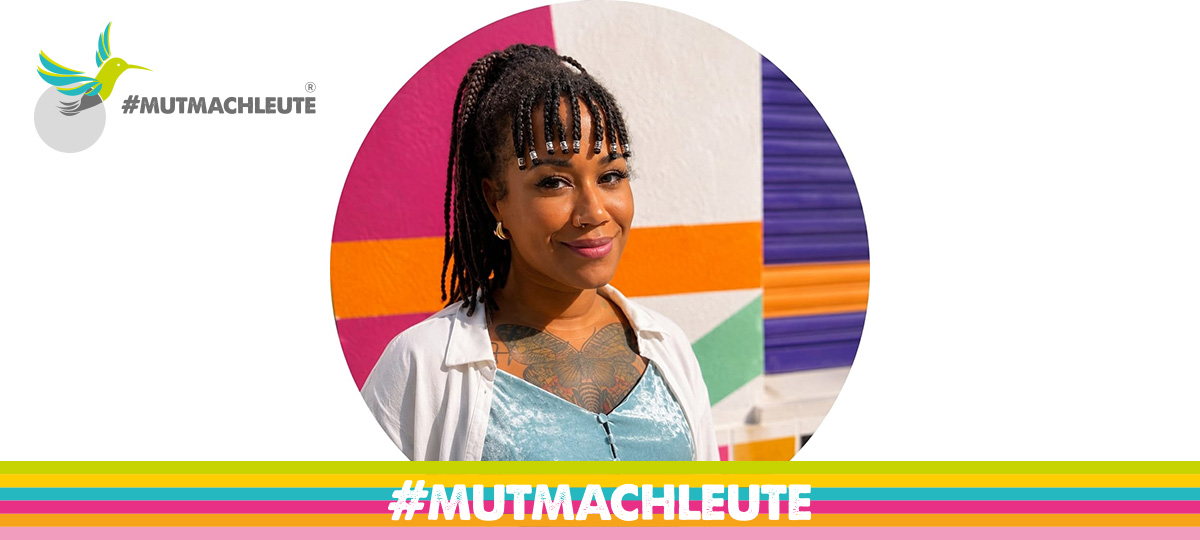
Looking Back, Moving Forward! – I Turn My Past into Strength for What Lies Ahead!
Name: Priscilla Sarah Candida Haage
Profession: EX-IN Peer Support Worker since 2017 (freelance), resilience trainer, DBT peer coach, visual social artist, founder of Atelier cocon coloré / Inclusion Space Community Art Space
Year of birth: 1988
Works with clients: People affected by personality disorders with borderline features, anxiety disorders, addiction, eating disorders and depression; people with physical and/or intellectual disabilities; family members, including siblings, children of parents with alcohol or heroin addiction, relatives of people with schizophrenia and family members of people with borderline personality features; as well as anyone, regardless of diagnosis, who wishes to develop their self-care, resilience, emotional regulation and creativity and strengthen themselves.
Therapeutic and support services: Peer counselling, resilience and skills training (DBT peer coaching), self-care and strengthening self-esteem, guidance towards social psychiatric services, individual support, talks, group programmes, services for businesses, workshops and art-based activities.
What personal crisis experiences have you had as someone who has experienced mental health challenges yourself? In which areas have you become an expert through experience?
I am an expert through my own experience and my personal recovery journey. My own experiences include a personality disorder with borderline features, addiction, binge eating and anxiety disorder. I have also experienced being a family member of someone with heroin addiction and growing up as the child of parents with alcohol addiction.
What was once my greatest challenge has become my strength. My intensity has become a gift. My experiences allow me to accompany and support others on their own journeys with understanding, empathy and authenticity.
To what extent do you believe recovery and a good life with a mental health condition are possible?
We, the recovery movement, have ushered in the end of the belief that recovery is impossible!
YES – I believe that recovery is possible and that you can live a good and fulfilling life despite having a mental health condition! Some conditions can go into remission. This means developing such effective ways of managing them that, eventually, you experience little or no suffering or impairment as a result.
For me, however, it’s not always simply a question of being “ill or healthy”. One concept that is particularly important to me is recovery. Recovery is a very individual journey. It’s about changing your own beliefs, values and relationship with your emotions, and learning to lead a self-determined, fulfilling and hopeful life despite mental health challenges.
For me, recovery is also an ongoing learning process. Crises aren’t just something that set you back; they can also create opportunities for development and change. Personally, I often experience crises as little metamorphoses. After a crisis, I frequently reach a new stage of personal development because something inside me has changed.
Sometimes it’s only through a crisis that I realise something no longer fits who I am, or that I need to take a closer look at a particular issue. I see these as my personal challenges, opportunities to learn something. I take something away from every crisis and grow through it. For me, it’s a process of learning, growing and constantly becoming someone new. That’s how I experience my post-traumatic growth.
Crises are part of life for me. Everyone can experience a crisis, regardless of whether they have a diagnosis or not. What matters is how we learn to deal with it and what we take away from the experience!
What prejudices and misconceptions exist in society about the conditions that have also affected you?
Borderline personality disorder
- Self-harming behaviour is just attention-seeking.
- People with borderline personality disorder cannot love and are manipulative.
- The condition is incurable.
- “Stop making such a big deal out of it. You just need to think differently.”
- They cannot maintain stable relationships.
Addiction
- Once an addict, always an addict.
- They’re all just junkies.
- They don’t have enough willpower.
- People with addictions are to blame themselves; they simply don’t want to work.
Eating disorders
- They just need to eat more or less.
- It’s nothing more than a loss of control.
- It’s not a real problem.
And these are just a few examples of the prejudices and stigma that people affected by these conditions encounter.
How do you personally support people affected by mental health conditions in care facilities, and what therapeutic approaches do you find helpful?
Listening and being there – simply listening without judgement, offering support and staying alongside someone through difficult moments.
Recognising strengths and encouraging people – discovering personal resources, building self-confidence and encouraging people to take their next steps.
Being a voice for others – supporting people’s needs and wishes and advocating for them when they want this.
Self-care and strengthening self-esteem – learning to recognise personal needs, set boundaries and develop a compassionate and respectful relationship with oneself.
Skills training – discovering helpful strategies for difficult situations and crises and learning to apply them in everyday life.
Managing emotions and tension – learning to understand and regulate emotions and cope with inner tension.
Mindfulness and meditation – finding calm, being present in the moment and strengthening self-awareness.
Empowerment and self-efficacy – rediscovering personal abilities and opportunities and experiencing: I can make a difference and have an influence on my own life.
Individual support and goal-setting – working together to identify what matters most at the moment, setting goals and implementing them step by step.
Resilience training – strengthening personal resources and developing better ways of coping with challenges and crises.
Accompanying people to appointments and public authorities – providing support during medical appointments, administrative appointments and other important meetings.
Administrative and bureaucratic matters – offering guidance and support with organising, understanding and completing applications and paperwork.
Finding therapy and navigating support services – providing guidance when looking for suitable therapy and support options.
Reintegration and participation – supporting people as they return to everyday life, work, meaningful activities and social structures.
Leisure activities – discovering interests together, planning activities and finding suitable opportunities for free time.
Group programmes and workshops – opportunities for exchange, skills training, creativity, resilience and personal development in a group setting.
Awareness-raising and psychoeducation – providing accessible information about mental health challenges, ways of coping with them and available support services.
I offer intuitive support and accompany people as equals, tailoring my approach entirely to their personal situation, needs and what they require at that particular moment. My work is resource-oriented, appreciative and compassionate, creating a loving and safe space.
Drawing on my own experiences, my extensive knowledge gained through lived experience and my individual recovery journey, I can offer different perspectives and approaches to finding solutions. The breadth of my experiences allows me to bring a high level of understanding.
I act as a bridge between professionals and patients and provide additional support throughout treatment.
My special offering at COCON RAUM combines creativity as a means of self-expression and emotional regulation. I also help people discover their intuitive connection with themselves and their creativity and use it as a transformative force.
The studio provides a meeting place for inclusion, exploration and recovery.
Which therapeutic approaches do you find particularly helpful?
My experience with helpful therapeutic approaches is very diverse. I don’t believe there is one single type of therapy that works for everyone. What matters is finding an approach that suits the individual, their life situation and their specific needs.
The therapeutic approaches I have found helpful include:
- DBT (Dialectical Behaviour Therapy) and skills training
- Cognitive behavioural therapy
- Trauma therapy
- Psychodynamic psychotherapy
- Hypnotherapy
- Psychoeducation and complementary group programmes
- Creative and resource-oriented approaches
I have personally had very positive experiences with all the different therapeutic approaches listed above. I believe it’s important to remain open-minded and explore what is helpful and feels right for each individual.
What special abilities can people with lived experience develop? How can you, as someone with lived experience yourself, help them discover these abilities?
People affected by mental health conditions can develop special abilities throughout their lives. To me, some of these are genuine superpowers. Through all the experiences, crises and struggles, people develop qualities that cannot simply be learned or picked up from a book.
Because of their heightened sensitivity and emotional awareness, many people have particularly fine-tuned senses. They can perceive moods, people and situations very intensely, allowing them to experience and understand the world in a completely different way. This can also enable them to establish particularly special and deeper connections with others.
Emotions are sometimes experienced much more intensely and expressed more strongly. I don’t see this intensity solely as a burden, but also as a gift. It allows people to touch others, share something meaningful and enrich the world through their unique way of seeing things.
Through their many crises and experiences, some people also develop extraordinary perseverance. They have already been through so much that they are sometimes less easily thrown off balance. This can lead to remarkable resilience.
Creativity, the ability to learn, empathy, understanding and a particular speed of thought or perception can also be among these abilities. Some people are incredibly creative, others exceptionally caring or have a special talent for recognising connections. For me, however, this is entirely individual. Every experience and every life journey brings its own unique superpowers. What matters is eventually recognising what has grown out of difficult experiences!
I believe that every mental health challenge can bring new insights, knowledge and abilities. And sometimes something entirely unique emerges from that – your own light, which you can carry within yourself and then share with the world and give to others.
Visit Priscilla’s website: genesungsbegleitung.berlin
You can also find her on social media:
- COCON RAUM | Berlin | Facebook
- Facebook – COCON RAUM
- Atelier cocon coloré – Instagram
- COCON RAUM – Instagram
Ähnliche Artikel

Depression: Keep on fighting!

Depression and Panic Disorder: Things Do Get Better. The Road to Recovery Is Difficult, but Things W...

Depression: Depression is an illness, not a character flaw, a weakness or a reason for prejudice.

Schizophrenia and Anxiety Disorder: Finding the Right Perspective and Learning to Defend Yourself Sp...