
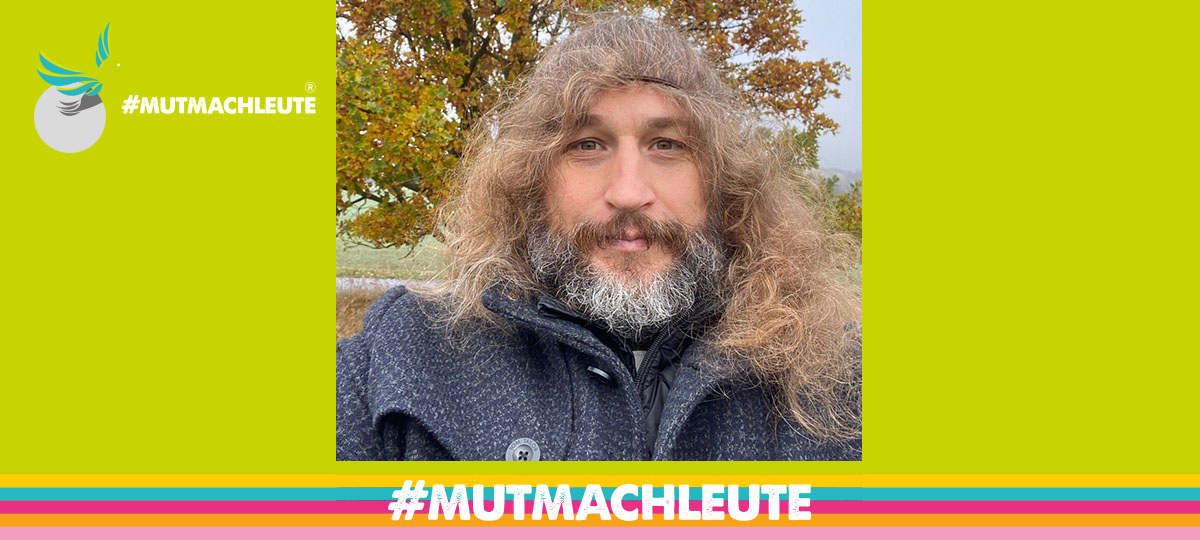
Schizophrenia and Anxiety Disorder: Finding the Right Perspective and Learning to Defend Yourself Spiritually Hold the Greatest Potential for Healing.
Person affected: Philipp Drescher
Year of birth: 1986
Diagnoses: Anxiety disorder (since the age of 15), paranoid schizophrenia, at times schizoaffective disorder
Treatments: Since 2009, almost exclusively medication, and a great deal of it. Also cognitive behavioural therapy. For around five years now, no further treatment, and no psychiatrist either.
Personal resources: Faith, writing, grounding and relaxation exercises, and personal spiritual practices.
How and when did you first learn about your condition?
The anxiety disorder came first, when I was 15. The psychosis-related diagnoses followed later, from 2009 onwards: paranoid schizophrenia and, at times, schizoaffective disorder. The treatment I received consisted almost entirely of medication, and quite a lot of it. I also underwent cognitive behavioural therapy.
What I did not receive was an explanation that matched what I was actually experiencing. I had studied medicine and was familiar with the way the medical profession thinks. Even so, the gap between what I was being told and what was actually happening remained.
Why have you decided to show your face and share your story now?
Because I have been writing about these things for years, and remaining anonymous would feel half-hearted. And because I have something to say that is rarely said.
I am a Christian. I believe that much of what psychiatry classifies as a symptom is something else: a process taking place on a spiritual and emotional level. Hearing voices, or what is known as ear-whispering as a technique used by sorcerers, is already mentioned in the Bible. And billions of people are familiar with the idea, through their religions, that there are forces we cannot physically touch. This was not always considered an illness.
How did the people around you react when they found out about your illness, and how would you like them (and society) to approach your condition?
My family and friends have been supportive and respectful from the very beginning. I am grateful for that; it is not something to be taken for granted. However, they were not particularly comfortable talking about it.
That is exactly what I would like to see change, both among family and friends and in society as a whole: not more sympathy, but more conversation. Anyone who has received a diagnosis immediately notices when people avoid a particular subject.
What has helped you most in coming to terms with your illness?
To be honest, I have never accepted it as an illness. What helped me was the opposite: stopping seeing what I experienced as a defect and starting to examine it.
We are spiritual and emotional beings, and we are more closely connected to one another than we think. Good and bad things are passed on internally. Those who cannot cope with this or interpret it incorrectly end up in hospital with psychosis. When I began to interpret it correctly, it became manageable.
What resources do you use in times of crisis?
Grounding exercises and relaxation techniques, practised daily rather than only when things reach a breaking point.
I also use my own spiritual practices: spiritual protection and the inner coping techniques I describe on my blog. For me, these reliably help dissolve anxiety, low moods, rumination and even paranoia, often surprisingly quickly. This is my personal experience, not a promise or a substitute for medical care or therapy. Anyone taking medication should discuss it with their doctor, not with me.
What would you like to say to other people affected by mental health conditions?
You are not broken. You are experiencing something you do not yet have the right framework to understand, and learning how to make sense of it is possible. Find techniques you can use yourself and practise them when you are feeling well – that way, they will be there for you when things get difficult. And do not let anyone tell you that nothing can ever change. Things have changed for me.
What would you like to say to family members and loved ones? How can they best support you while also looking after themselves?
Talk about it. Silence out of consideration is usually harder for the person affected than an awkward question. Ask what is going on and, at least initially, believe the answer, even if it sounds strange.
Blame is completely unnecessary: In my faith, your soul will find comfort at some point, and at present we rarely recognise that we are interpreting spiritual and emotional dimensions entirely incorrectly. Many people are ill because they are being attacked or persecuted on an invisible level. Particularly in the case of mental health conditions, as well as other apparent failings, the underlying causes are often quite different and only become apparent later.*
What defines your character, and which personal quality do you value most about yourself?
I never give up, and I am willing to look closely, even when things become uncomfortable. What I value most about myself is that I keep asking questions until it hurts – and later, that very process brings relief. It has cost me certain things, but it has also brought me to where I am today.
Take a look at Philipp’s website: deprisoner.de. You can also find his books there: Besser leben mit Schizophrenie – Hilfe zur Bewältigung und Gesundung (Living Better with Schizophrenia – Support for Coping and Recovery) and Fit für die Drachenspiele? – Bewusstseinskrieg, geistige Verteidigung, Aufbau innerer Stärke und Gesundheit (Ready for the Dragon Games? – Consciousness Warfare, Spiritual Defence, Building Inner Strength and Health). Spiritual coping strategies and spiritual defence are also available for other diagnoses.
Philipp is also on Pinterest: de.pinterest.com/deprisonerde
Ähnliche Artikel

Depression and anxiety disorder: Think of the beauty you have achieved, and the negative becomes a s...

Paranoid schizophrenia: Giving up is a foreign word for me!
Anxiety disorder, depression, anorexia and borderline: I have the choice every day!

Anxiety disorder: The storm is getting stronger? Doesn't matter because so do I!