
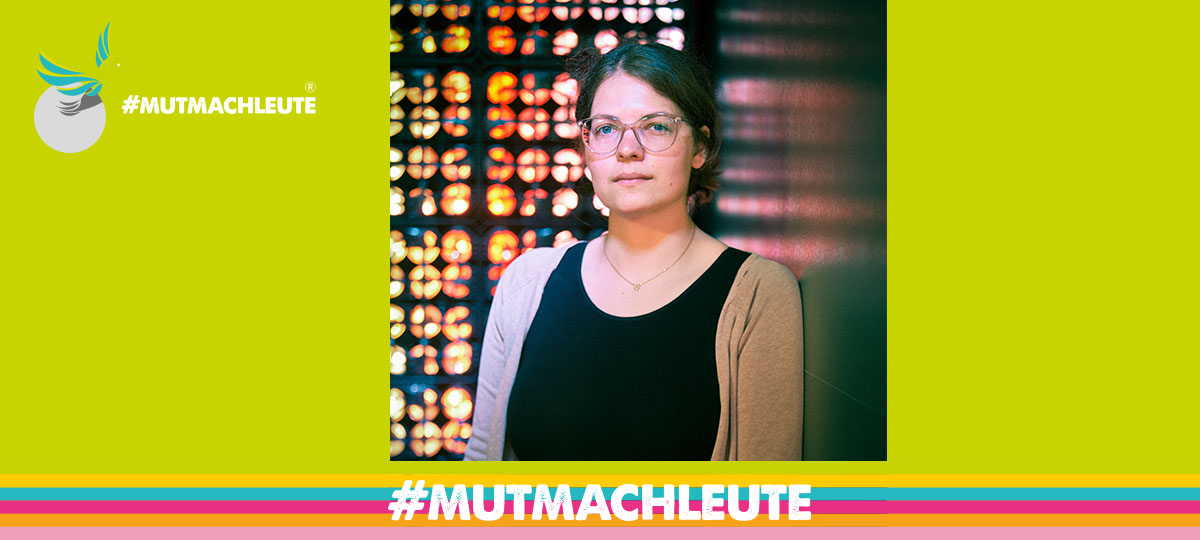
Understanding My Condition as an Opportunity
Person with lived experience: Anna
Year of birth: 1996
Diagnoses: Persistent mood disorder, dysthymia, chronic, with recurrent moderate depressive episodes, obsessive-compulsive disorder, somatoform autonomic dysfunction, specific (isolated) phobia, further conditions currently being assessed
Treatment: Outpatient psychodynamic psychotherapy, outpatient psychiatric treatment (including medication)
Resources: Voluntary work with wonderful people
How and when did I find out about my mental health conditions? How do I live with them? From the first signs to the decision to speak publicly about my life as a person with mental health conditions:
Essentially, there are two areas of difficulty: one that is acute and another that has been with me for as long as I can remember. Both occur in phases, which can run parallel to one another in a meaningful harmony as well as in a paradoxical coexistence.
Ever since childhood and adolescence, I have had a persistent feeling of being different. Until well into adulthood, I was tormented by the feeling that the people around me were withholding essential information about me and my health. Almost every day, I had thoughts such as: “I’m disabled* and everyone knows it, but nobody tells me.” In my mid-twenties, this gradually changed into the realisation that my “problems” were more likely to be personality traits and that I had to accept myself as I am. This helped me enormously in learning to accept myself.
Throughout my life, I have experienced extreme insecurity when communicating directly with other people – surprisingly, often with those I find particularly likeable and trustworthy. I can only recognise facial expressions, gestures and other forms of non-verbal communication during “good phases” or “neutral phases”, and then only in people I have known closely for most of my life (such as my parents and sister). I can see that someone is looking directly at me, but I cannot interpret their intention. I also have limited control over my own non-verbal communication. People often tell me that I come across in a certain way, even though what is happening inside me is usually the complete opposite, and I am sure that this is what I am conveying. I have “stored” many behaviours and social expectations based on stories and accounts from my mother, who is an educator, about observations from her professional life, and added them to my internal “checklist”. When I find myself in a relevant situation, I mentally bring out this checklist and remind myself to try to behave in the way that apparently is expected of me. Whenever I do manage to recognise other people’s body language, I repeatedly catch myself telling them what I have observed – or at least feeling a very strong urge to do so.
This inability to recognise and interpret social cues naturally has a huge impact on my everyday life. I find phone calls difficult because I never know when it is my turn to speak, and I interrupt people even more often than I do in face-to-face conversations. I have got better at this, but it is still incredibly stressful. Whenever important information needs to be exchanged, I prefer written communication – not least because it gives me a record of what has been said and the opportunity to present my concerns in a reasonably structured way. This is important because my ability to understand spoken language is sometimes severely impaired. In these moments, what is being said sounds to me like a muffled noise, or as though the person I am talking to is speaking in a foreign language I do not understand. I am also usually distracted by stimuli in my visual and auditory surroundings. In these situations, I push myself beyond my limits, trying to perform and appear “normal”. When I can briefly escape shortly afterwards (for example, by going into another room), with my heart racing, difficulty breathing, stomach pains and tears in my eyes, I start screaming internally and bite into my scarf or something similar. These panic reactions during direct interpersonal interactions are part of my everyday life. Sometimes, several things happen simultaneously. I become aware that I am behaving in a way I usually did not intend to, and observe myself as though I were detached from my own body, but I am unable to intervene or stop what is happening.
Because I find it difficult to judge the appropriate level of closeness or distance in my relationships with people I communicate with, even writing emails can take a very long time. I feel unsure about which wording is appropriate. I also find it difficult to address people by nicknames unless they have explicitly told me in a direct conversation that they would like me to do so. All of this makes it difficult for me to establish and maintain close relationships or even friendships. Quite simply, I do not understand how it works. And not being able to tell whether someone is merely being superficially friendly towards me or is sending me signals that I can neither recognise nor interpret does not exactly help. The paradox is that I long so much for closer interactions with others. I need them to feel nourished and supported, yet at the same time they are harmful to me. I often start feeling unwell while I am still at a social gathering or meeting. As soon as I get home, I become paralysed and feel ill, even though I was really looking forward to seeing the person or people. I cannot get out of bed, stare at the ceiling endlessly and cry because it frustrates me so much. This state can easily last a week. That is why I prefer activities where people do things together, but where constant direct interaction is not necessary and short breaks are possible.
In general, I feel that I perceive the world and everyday life differently from most other people. My focus in everyday life is directed towards different things. For example, a normal shopping trip is a major activity for me, not something I do on the side. I have to plan it properly because this one task places considerable demands on me on several levels. One defining moment occurred during a university research project. One of the tasks was to settle down in a particular place and consciously pay attention to the surroundings for an hour. When we discussed the exercise as a group, everyone else took turns describing how new and different their impressions had been, and how they had noticed sounds, smells and visual details that they had never consciously registered before, particularly not in such variety and all at the same time. That was the moment when I first realised that something about the way I function was different. Although the main task in that situation was to focus on perception, I too processed impressions and stimuli more consciously than usual. Nevertheless, with every account from my fellow students, I thought: “But that’s completely normal. That’s what it’s always like, isn’t it? You perceive all these things at the same time. Why is this being singled out as something so special?” Later, I asked a few individuals again whether it really had been so different and new for them, and whether they did not also always take in so much information, then simply choosing to focus on one thing by consciously concentrating on it. Until then, I had sometimes considered myself strange in certain respects, but never because of the way I perceive things.
Conscious decision-making and control are central aspects of this. I have developed strategies to help me concentrate and minimise distractions from environmental stimuli. For example, I switch my ears into “noise mode” or deliberately make my vision “out of focus” so that I can move around the city (for example, when cycling or driving) or, in the latter case, follow conversations more easily. These strategies work reasonably well, but they take a great deal of strength and energy. This can be particularly challenging at work. As soon as I hear a noise, I can no longer concentrate on my tasks and it takes me a long time to get back into a focused state. Even in primary school, my reports said: “Anna usually works purposefully and persistently. However, she often needs a lot of time just to get started. […] Her working pace is rather slow. […] With the necessary motivation […] and good concentration […] she is increasingly willing to learn and make an effort.”
I have a strong need for reassurance and security: clarifying the conditions, establishing continuity and only trying new things within these (broad) familiar boundaries. Change is incredibly stressful and manifests itself in difficulties adapting. Even if I look back on a change positively, I cannot feel happy about it at first. It disrupts my familiar structures. Unfortunately, my initial reluctance is often interpreted as negative or unappreciative behaviour. That makes me sad, because it is not what I mean. Spontaneous changes are particularly difficult. For a long time, if someone suggested meeting up at short notice, the earliest I could manage was three days later. This has improved considerably. A few years ago, I managed to let go of my strict daily routines. I stopped making lists because I wanted to feel freer, more approachable, more accessible and more socially compatible. (In addition to daily to-do lists, I used to plan holidays almost down to the minute.) This did make me more spontaneous, but at the same time it plunged my life into chaos. Nevertheless, everything inside me resists going back to making lists. The indifference that began to set in alongside increasingly frequent and intense depressive episodes also had a positive side in this respect (“It doesn’t matter anyway. I have no influence over it.”).
As far as I can remember, my depressive episodes began when I was about 12. That is not to say that everything was wonderful before then. Until that point, I had been able to block out or imaginatively work through many things by losing myself in my own fantasy world. From that age onwards, I also remember my family repeatedly telling me, a judgement that continues to this day, that I always think so negatively. I should try looking at things more positively. I never actually perceived my thinking as negative. I saw it as critical and rational, and often as non-judgemental and observant. Even as a child, I was frequently told that I thought or wanted to act too much like an adult. And, in fact, I was often more interested in “adult topics and conversations” than in the things that interested other children my age.
I love analysing things, immersing myself in complicated, thought-provoking subjects, playing strategy games and observing people. I can become wonderfully absorbed in new interests. They take up a great deal of my time and also become a major presence in all areas of my life. And my absolute favourite thing to do is organise and arrange things. For example, I used to sort the cutlery in the cutlery drawer, and it would completely throw me off balance if someone else failed to keep it in that order. I would need a few minutes to collect myself again because a fundamental structure in my everyday life had been disrupted. My family and friends have never understood why I attach so much importance to this. I have now been living away from my parents for several years. It still unsettles me internally, but it is easier to deal with because it is no longer part of my daily life.
Since autumn 2013, I have had severe digestive problems. Medical tests found no cause. After the symptoms became increasingly worse, culminating in late summer 2018 in my being able to eat nothing or, at most, a few spoonfuls of food a day, I was referred to a specialist outpatient clinic and nutritional counselling. This was followed by a strict diet and a gradual reintroduction of normal foods. I learned what I can eat and what I need to do, and when, to feel reasonably well. I do not want to complain about this: it has become manageable and is better than I could ever have imagined. However, the constant fear that the severe symptoms might return one day remains. For a while, I had things well under control and was able to discipline myself because of how much I was suffering. At the moment, I do not have the strength to do that.
My first physical breakdowns occurred in November and December 2019. I realised that I needed support. The pandemic and the clearly defined rules of behaviour that came with it (greeting rituals, no frequent social contact) actually suited me very well. At last, I no longer had to justify why I rarely spent time around other people. And the uncertainty about what was expected of me when greeting or saying goodbye to someone eased – everyone was supposed to keep their distance. The question “Is a hug appropriate now? Or should I wave or shake hands instead?” was finally less present in my mind.
Towards the end of the year, the situation deteriorated dramatically. Have you ever fainted while sitting in front of a camera during a video conference? That was when I knew I had to pull the emergency brake. “Pause.” I went abroad for several months. This was also a major challenge because I had to leave behind many of the things that made me feel safe. At the same time, I always knew that it was only a temporary break. Even so, I kept telling myself that I would take things more easily in the future and that everything would get better. I can manage on my own! As soon as I returned, the stress came back and grew worse and worse. I half-consciously covered it with a cloud of indifference, assuming that everything would automatically improve and simply fall away once I had completed my degree. So I just had to grit my teeth and carry on.
I can get through one more year, and then – yes, then – everything will be better!
In reality, the only thing that disappeared when my workload ended was the stress that could theoretically have been shaken off. The deep-rooted problems I had buried beneath the sacrifices I made for my studies remained.
Since July 2022, my language abilities have increasingly deteriorated: my language skills and ability to express myself have diminished. I frequently forget words and terms, and it takes me a very long time to put together meaningful sentences, even in everyday situations. This creates additional, considerable insecurity. I have severe concentration problems: even over short periods, I cannot remember many things. For example, I often forget what I was just about to do, which means I need an enormous number of attempts even to complete small tasks. I also have serious attention problems: “Oh, there’s a speck of dust floating past.” I have extreme difficulty dealing with sensory stimuli, particularly sounds and light. In the most severe cases, even leaves falling from trees can become too much for me. I also have extremely severe difficulties with social interaction.
I often lie paralysed in bed, staring at the ceiling and unable to do anything. Sometimes I stand in my room facing the wall and wonder how hard I would have to hit my head against it to finally have some peace and quiet. Sometimes I raise my arm to strike, but stop because the risk is too great. What if I hit it too hard? I might end up physically disabled, perhaps unable to communicate at all, and then other people would make decisions for me. I might even be brain-dead. I have an advance healthcare directive. It states that if I were to develop a cognitive impairment that meant I could no longer live independently or make my own decisions, all life-sustaining measures should be discontinued. Realistically speaking: would doing this achieve the effect I want? Is the risk worth it? I decide against it. Better to cry every day, feel desperate and hope things will improve.
From January 2023 onwards, the whole situation deteriorated dramatically. Frequent episodes of sensory overload, bringing me to the brink of a breakdown or actually causing one, became part of my everyday life. So this is it: the long-awaited relief, the end of my studies that I had so desperately looked forward to! From then on, I spent about a year and a half in a foggy, dull state. My head felt as though it were undulating, as if fog or haze made it impossible to think or concentrate. Strong defensive reactions set in as soon as anything might trigger a potentially stressful or overwhelming situation. I feel sleepy and slow-witted. I usually have a feeling of pressure in my head all day, frequent headaches and a ringing in my ears. At the same time, a growing sense of indifference – towards personal matters, principles and values, as well as life in general – has been spreading inside me. It had already been creeping in gradually since March 2022.
Lack of motivation, lack of direction: I no longer recognise myself. Almost everything that once mattered to me and that I thought defined my character (such as reliability, punctuality, being organised, keeping things tidy, openness, being a good listener, taking a genuine interest in other people, determination, perseverance, curiosity and patience) has disappeared. Now, as if behind a kind of protective shield, I have become unpleasant, nasty, unpredictable and self-centred. I bore myself. I do not let anything new into my life. Even in the few conversations I have, I keep talking about the same things because I am afraid of new information that I would then have to process. I feel increasingly lonely, even though I want the exact opposite. I am tormented by the feeling that my mere presence, working with others or taking part in shared activities is a nuisance and an unnecessary burden on them. I have nothing of value to contribute in social situations. The reactions I perceive – assuming I perceive and interpret them correctly – consist exclusively of brief exchanges or conversations that are abruptly cut short. While other people chat with one another, even casually, doing so with me seems unimaginable. When I try to start a conversation, my attempts are almost always blocked or ignored. At least, that is how it seems to me. At the same time, paradoxically, whenever the subject turns to my imminent departure from my current workplace, people repeatedly tell me how sad it would be and what a loss it would be. I cannot tell whether they mean it. And as if all this were not enough, I have also fallen head over heels in love with someone, with absolutely no hope of it ever being reciprocated. Well done, Anna. Brilliant timing!
I am terrified of falling into a hole that I will never be able to climb out of. I make a plan to recover and regain my strength by autumn 2023. Fortunately, an important part of my everyday structure remains in place because my employment contract is extended. At least I have a reason to get up, look after myself and go outside. I am convinced that I simply need to learn how to deal with my new everyday life and my newfound freedom. The bitter realisation is that all of this was just procrastination. Having fewer tasks and commitments did not bring about any recovery. Simply existing and living is a burden to me. Even though a 20-hour working week should leave me with plenty of free time, it feels like less than I had while writing my master’s thesis (Monday to Wednesday: work, housework, exercise, etc.; Thursday to Sunday: 16 hours on my thesis, sleep). I cannot get out of bed in the morning, or find it very difficult to do so. Apart from daydreaming, which used to be the reason I stayed in bed for so long but is now increasingly fading into the background, and occasionally dozing off – something that is becoming more frequent and leaves me even more tired – I simply feel exhausted. Every day, I start procrastinating all over again, trying to put off for as long as possible all the new, unpredictable, but also foreseeable experiences that lie ahead. However, this does not relax me. It only frustrates and stresses me even more. I cannot break out of this pattern. My lack of self-confidence and poor assessment of my own abilities are weighing me down. My social and communication difficulties are causing me immense and increasing distress.
At the end of November, the situation escalates following an incident at work that is actually quite minor. For the first time, I seek professional help. The psychotherapeutic consultation is helpful, even though I find the therapist anything but likeable. I do not feel understood by her either. But it feels so good to finally let out so many unspoken thoughts and tears. Of course, 50 minutes are nowhere near enough to even begin to give an overview of everything that is going on. She fixates on one topic that is certainly important, but is not even the core of what I have just told her. Finally, she asks whether I am suicidal. No, I am not. Surprisingly. Even though I feel so terrible, some tiny part of me still sees a reason to carry on. She then ticks “inpatient psychiatric treatment” on the PTV 11 form. Apparently, I should admit myself to hospital as soon as possible. But she does not explain how to do that. At that point, I also do not know that I need, among other things, a referral with a special appointment code just to have a chance of getting an initial consultation with a specialist. Initially, I feel relieved that I have taken this first step and am even somewhat optimistic. The biggest hurdle has been overcome.
I assume that it will be impossible to get an appointment so close to Christmas. On the very night I finally pulled the emergency brake and booked the psychotherapeutic consultation through 116117.de, I simply wrote down everything that was going through my head. I have to be prepared, surely, otherwise nobody will believe me. I end my account with these words:
As I write all this down, it even seems completely absurd to me that I simply put up with so much, push it aside or carry on regardless. But it also shows me that I have to actively change something if I want things to get better.
The thought keeps coming back that there are other people who are much worse off than I am. Would I be taking away their chance of getting therapy? By now, I no longer care. What use am I to society if I am unable to perform, even though I have so much potential? I am increasingly experiencing physical symptoms (digestive problems, various inflammations, including my gums and skin, and general exhaustion) that simply do not go away. On top of that, I feel increasingly burdened by the current political and social situation. I am not yet entirely sure whether these issues themselves are the cause or whether I am generally overwhelmed by the process of becoming an adult. It is probably a mixture of both. By the end of February, my physical deterioration has progressed so far that I visit a GP. So far, she is the first person to show me genuine understanding. She gives me a referral for psychiatric treatment. She also wants to sign me off work for an indefinite period. I refuse. “Please don’t take away the last few weeks of the only structure and immediate social contact I have left,” I plead with her. She agrees, but emphasises that I must go to an emergency department immediately if my condition deteriorates further.
Finding an initial consultation is no easier this time either. I spend several hours every day searching and contacting providers. Neither my health insurance company’s appointment service nor the 116117 appointment service can find me an appointment. Is it really possible that there is not a single appointment available in all of Berlin and the surrounding area in the coming weeks or months?! Apparently, my suspected diagnoses are simply not serious enough. I am told to call around myself. The outpatient departments of the city’s hospitals are recommended to me as an “insider tip”. Great. Just wonderful! I am already far from being the best version of myself, and now I am supposed to make phone calls – a form of communication that has always been a major challenge for me. Overcoming this hurdle is incredibly difficult, and it places an unnecessary additional burden on me in an already critical state. But apparently, it is the only chance I have left. I call every outpatient department. At one, I am told: “You don’t live in our district? Then we can’t treat you. Hospital XY is responsible for your area. Have a nice day.” When I call there, I hear: “No, we can’t help you. And we aren’t responsible for your care either. Here’s the number for the inpatient unit. You can ask them whether they might have a bed available in a few months.” But I don’t want inpatient treatment. Why doesn’t anyone understand that?! All I need at this stage is an initial consultation.
After several desperate phone calls and heartbreaking voicemail messages to different providers, I call 116117 once again and arrange a second psychotherapeutic consultation. This appointment is the turning point. At last, I feel heard. There is a second appointment, then a third. And finally, I receive the long-awaited news: “I would like to offer you a place in therapy.” Breathe. Slowly. In. And out. From now on, things can only get better. And, in fact, on the very same day, during my final call to a psychiatric outpatient department, I manage to get an appointment that is only four weeks away. “Only” is relative in my condition, but at least it is not a year away – or unavailable altogether.
Suddenly, everything happens very quickly and events come thick and fast. A spontaneous decision is made that I can stay at my workplace for longer. Relief. I begin psychotherapy and, shortly afterwards, psychiatric treatment as well. I have spent a long time thinking about taking medication. I am usually rather reluctant to take it unless it is really necessary. Should I really commit to taking pills for an indefinite period, perhaps even for the rest of my life? I am not particularly enthusiastic about the idea. If I am to consider medication at all, it is only in combination with talking therapy. In the end, I decide to give it a try. There is nothing normal about my condition anyway. Besides, I do not want to end up like my father, who took antidepressants for a while but then stopped taking them on his own. From the outside, it is quite clear that this was not necessarily the wisest decision. So I decide to give it a chance.
Today, a good six months later, I am both proud and relieved that I managed to seek professional support. It was one of the best decisions of my life. The medication does have some unpleasant side effects, but it makes it easier for me to engage with therapy and reduces my general stress levels. Being under its influence is a very peculiar feeling, and it took me a good two or three months to understand what it was like. It is neither a high nor a state of numbness. It feels as though I am walking on cotton wool. Everything is cushioned in a strange way, pleasant and soft – or quite simply not important enough to trigger negative thoughts. I cannot get annoyed, upset or angry with anyone – and especially not with myself. I can simply accept things and let them be. It feels indescribably good! Sometimes, on a rational level, I get annoyed that I cannot feel annoyed on an emotional level. For example, in situations where getting angry would actually be entirely justified. But then I think to myself: isn’t it also wonderful to feel like this right now, like a Care Bear walking on clouds and sliding down a rainbow? By now, I have reached a point where I am more than happy to accept this compromise. I do not know what will happen next. And, of course, there are setbacks, too. But that does not matter. I am on the right path.
Why did I decide to show my face and share my story?
I like standing up for causes that benefit society. Making a public statement like this is not something I take lightly. When I decide to get involved, I am fully committed to it. I want to live in a society, in an environment where people with mental health conditions and disabilities in general receive the respect they deserve, where all those who are supposedly “normal” treat us as equals and do not strip us of our dignity by talking about us instead of with us, making decisions for us without involving us and taking away our right to make our own choices. We are more than our illness or disability. We are people with hobbies, jobs and friends. We are the person standing next to you on the underground. We are part of this society and want to be seen and treated as such. I have a chronic illness. So what?
How did the people around me react when they found out about my condition, and how would I like them (and society) to respond?
The few people who know were surprised, but understanding. It is different with my mother. When I previously told her about my problems and confided in her, she showed little understanding. She usually responded with comments such as: “I know what that’s like. I felt the same way in that situation.” or “It’s difficult for everyone.” It was only when I told her about my therapy and that I was taking medication that she acknowledged that I was experiencing serious difficulties and was not just imagining them. Only recently has she sometimes added afterwards: “Of course, it’s a little different for you.” But if sentences such as “If you ever have something really serious [meaning physical illnesses], you’ll be glad…” follow shortly afterwards, everything that was said before seems to evaporate into thin air. It will probably take more time – for her and for our society – before mental health conditions are recognised as being equal to physical illnesses in terms of their severity and the suffering they cause.
However, most people around me do not know about my health. I find it particularly difficult to talk about it at work because I fear negative consequences. Who would renew the contract of an employee with a mental health condition, or even hire someone like that in the first place? They might be off work at any moment. The fact that people only know me in this condition, without realising it, is not taken into account when they judge me.
Stand up for easily accessible ways of contacting support and treatment services. Having to do an unnecessary amount of research, finding vague or contradictory information on websites and being offered contact options exclusively by phone are not accessible!
What has helped me most to accept my condition?
My condition itself forced me to accept it. A good four years after realising that I would not manage without professional support, my body punished me for suppressing everything through physical deterioration. Nobody could help any longer. “There are no physical causes for this” was the standard response at medical appointments. Eventually, in the middle of the night, I booked an appointment for a psychotherapeutic consultation for the following day, after a situation between a colleague and me at work had escalated. That was when I decided: I cannot go on like this! When I finally got a place in therapy a little over four months later, the fact that I had been able to take this step and acknowledge my condition also helped me accept it.
By now, I also see my condition – or its deterioration – as an opportunity. I need to change the way I live and take even better care of myself. This automatically means that I have to engage more with my needs and boundaries and reflect on my actions more often than other people do. My condition also makes me more sensitive to the experiences of other people who face stigma.
What resources do I turn to in times of crisis?
Tidying up, sorting and decluttering things; volunteering with wonderful people, because the world does not revolve around me alone; daydreaming or listening to podcasts (not always the best choice when obsessive thoughts are involved, but effective in certain situations); repeating reassuring phrases to myself like a mantra.
It’s still a long way – I’m only at the beginning.
What defines my character, and which of my qualities do I value most?
I have a wide range of interests and love immersing myself in new research. I also have an exceptionally high tolerance threshold and a strong sense of justice and injustice. That is why I enjoy getting involved in processes of change and prefer to learn about different attitudes and positions first-hand, even if they contradict my own. First listen, then draw conclusions, and only at the very end decide what actions to take.
What would I like to tell other people who are affected?
Be brave and seek help! Don’t wait until things get even worse. They won’t get better on their own. You deserve to be listened to and supported. There are probably other people who are having an even harder time than you. But that is beside the point. You are valuable and deserve all the help you need! ❤️
What would I like to tell family members and friends of people affected? How can they best support us on the one hand, and themselves on the other?
Listen and take the crises and problems of the person you are talking to seriously. Offer to help them find and arrange an initial psychotherapeutic consultation, and simply make sure they know they can talk to you. Being there for someone helps more than any advice you might be tempted to give.
*A brief additional note on the term “disability”: Having grown up in a society where “disabled” is used as an insult, I too long regarded and used the term as something negative, derogatory or deserving of pity. Over time, I began to think more about what it actually means. Essentially, “disability” simply describes the fact that a person is restricted or prevented from doing something by something else. If I am driving along a country road and a fallen tree trunk is blocking the road, it prevents me from continuing my journey without interruption, as I would like to. A disability can therefore arise from external circumstances as well as from individual ideas about how to live one’s life.
Whether a person is disabled in a particular respect can therefore vary depending on one’s perspective. Personally, however, I believe that nobody other than the person concerned has the right to label them as such, let alone use that label as a standard by which to judge or assess them. Every person is more than that. That is why I have decided to use adjectives wherever possible. They describe characteristics without making them a person’s defining feature. Nouns are also usually used in combination with “have/has” or “am/is”. Saying that someone “has” an illness can suggest that it is something they own, like a material possession, which they can simply take off or get rid of. That is not always the case. Furthermore, illnesses certainly have an impact on personal development and character. If I had not experienced illness myself, I would almost certainly have less empathy for other people who are affected.
Ähnliche Artikel

Looking Back, Moving Forward! – I Turn My Past into Strength for What Lies Ahead!

Depression: Keep on fighting!

Depression and Panic Disorder: Things Do Get Better. The Road to Recovery Is Difficult, but Things W...

Depression: Depression is an illness, not a character flaw, a weakness or a reason for prejudice.